Market Update 16 June: Relief Rally, Not a Regime Turn
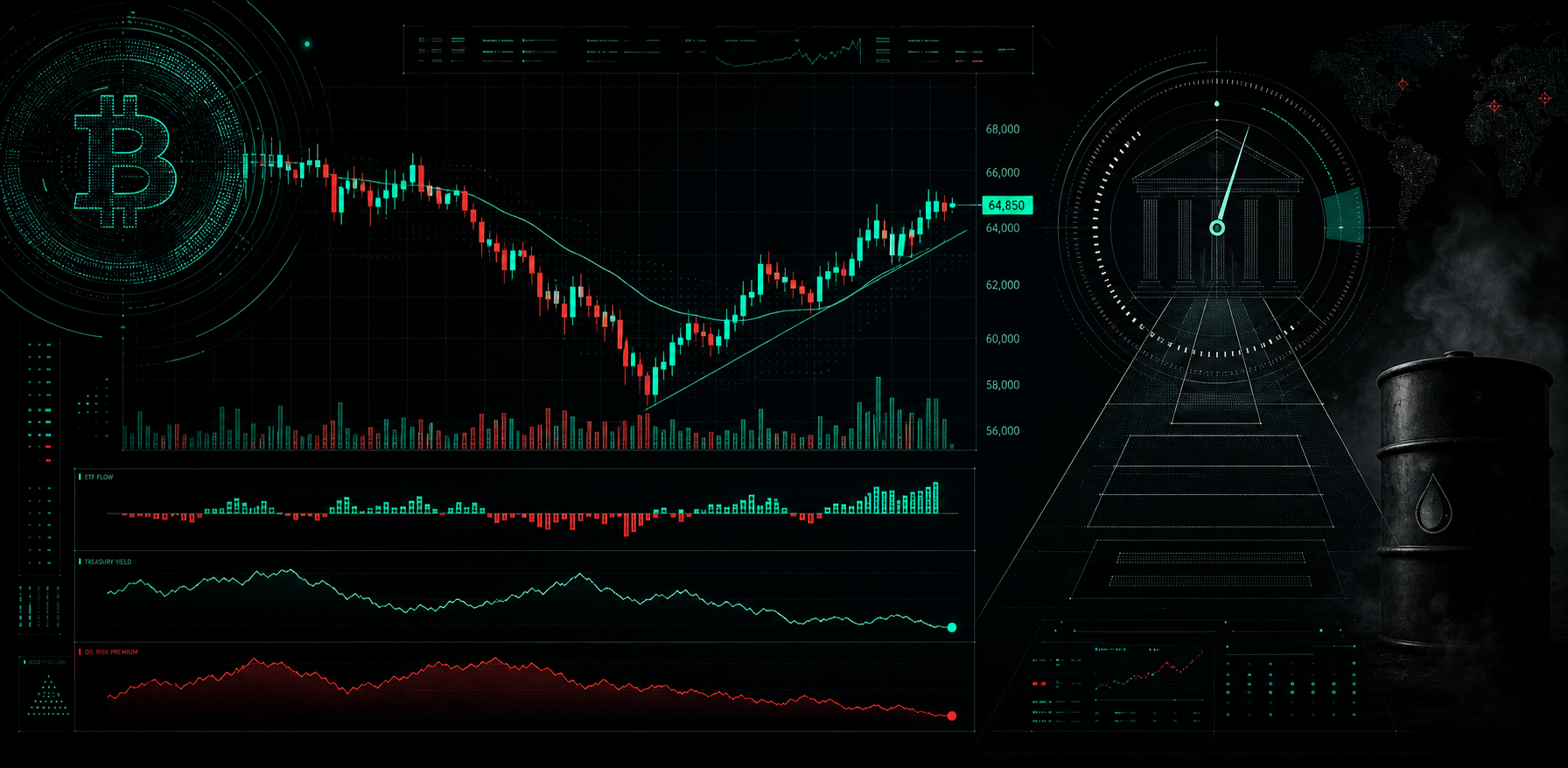
BTC has rebounded from the low $60k area into the $65k-$67k zone as oil, the dollar and front-end inflation fear all cooled at the same time. The tape is better, but our base view is simple: this is a relief rally until flows prove otherwise. The market has repaired positioning after a violent selloff, not rebuilt the liquidity engine that powers a durable crypto uptrend.
The key signal is not price. It is capital formation. Spot BTC ETFs finally printed a green session after heavy redemptions, but the prior outflow run was large; ETH ETF demand remains weaker; stablecoin liquidity has not yet turned decisively; and digital-asset treasury buying has slowed. Into the June 17 FOMC, the trade is binary: a dovish read on softer core CPI and lower oil can extend the squeeze, while a hawkish focus on 4.2% headline CPI likely sends BTC back into range stress.
At a glance
- BTC snapped a four-week losing streak and traded back toward the mid-$60k area, with several market dashboards showing BTC around $66.3k early on June 16.
- Macro did the heavy lifting: May CPI was hot on headline at 4.2% YoY, but in line with expectations, while core inflation softened to 2.9%. That allowed risk assets to breathe.
- The geopolitical premium is reversing. Reports of a U.S.-Iran ceasefire framework and the reopening path for the Strait of Hormuz pushed crude lower and supported equities, crypto and high-beta tech.
- ETF flows are no longer one-way negative, but they are not yet bullish. Farside Investors shows U.S. spot BTC ETFs taking in $85.9M on June 12 after a series of large outflows; another ETF tracker showed a trailing five-day net of roughly -$0.32B as of June 15.
- ETH is still the weak link. Farside ETH ETF data showed multiple recent outflow days, with June 12 at -$4.9M, while broader ETF data from ETF Action put Ethereum ETFs down roughly 40.8% YTD on performance.
- Our view: do not chase the first bounce as if the cycle has restarted. We want to see ETF inflows, stablecoin supply and treasury accumulation improve together before upgrading the rally from tradable relief to structural recovery.
Why the tape bounced
The crypto market did not bounce because the structural bull case suddenly improved. It bounced because the three biggest short-term headwinds stopped getting worse at the same time.
First, inflation came in ugly but not worse than feared. A 4.2% YoY May CPI print is not friendly for duration, equities or crypto. It is the highest headline reading since 2023 in the data series tracked by market desks. But the market had spent the prior weeks preparing for a shock that would force the Fed to validate higher-for-longer immediately. Instead, the print was broadly in line, while core softened to 2.9%. That distinction matters. Risk assets can handle bad data if positioning is already defensive and the data does not create a new surprise.
Second, the oil shock started to unwind. The ceasefire framework around the U.S.-Iran conflict and the expected reopening path for the Strait of Hormuz removed part of the geopolitical premium that had been embedded in Brent, the dollar and rates. Several market reports noted Brent falling sharply from the prior spike zone into the $80s, with one June 16 market note highlighting stronger crypto and tech sentiment as Middle East tensions eased. Lower oil does two things for crypto: it reduces the forward inflation impulse, and it weakens the dollar-liquidity squeeze that had been pressuring high-beta assets.
Third, positioning was already washed out. The prior move from the low $80k area down toward $60k liquidated late longs, reduced perp appetite and reset the speculative base. When macro stopped deteriorating, shorts had to cover. Bitget market data cited roughly $489M of 24-hour crypto liquidations, with shorts representing about $372M. That is classic relief-rally mechanics: not new conviction first, but forced buying from traders leaning the wrong way.
The Fed is the real event
The June 16-17 FOMC is the market's main catalyst. The rate decision itself is not the story; the market broadly expects a hold. The story is the dot plot, the inflation language and how the new Fed leadership frames the tension between sticky headline inflation and improving forward indicators.
There are two credible readings:
- Dovish hold: the Fed looks through the energy shock, emphasizes softer core inflation and acknowledges lower oil as a reason not to overreact. This would likely extend the relief trade, push the dollar lower and keep BTC probing the upper end of the current rebound range.
- Hawkish hold: the Fed anchors on 4.2% headline CPI, pushes back against easing expectations and leaves the door open to tighter policy if inflation re-accelerates. That would pressure equities, lift real yields and likely drag BTC back toward the low-$60k support shelf.
Our bias is that the Fed will try to keep optionality rather than deliver a clean risk-on signal. That means the crypto rally has to be treated as an event-driven bounce, not a confirmed liquidity pivot.
Crypto flows: stabilization is not confirmation
This is where we stay cautious.
The most important positive data point is that U.S. spot BTC ETFs stopped bleeding for at least one session. Farside shows +$85.9M of net BTC ETF inflows on June 12. Bitcoin.com also reported the same approximate figure and noted that none of the tracked spot BTC funds posted an outflow that day, after more than $1.67B had left the category in the prior heavy redemption stretch.
That is a good sign. It is not enough.
ETF flows are noisy day to day, especially after a selloff. A clean positive print can mean exhausted selling, but it can also mean tactical rebalancing after forced redemptions. The better read is the multi-day trend. A separate ETF flow dashboard showed U.S. spot BTC ETFs with roughly $102.6B of AUM and a trailing five-day net flow near -$0.32B as of June 15. In plain English: redemptions are slowing, but creations are not yet strong enough to call institutional demand back.
ETH looks worse. Farside's ETH ETF table showed June 12 net outflows of -$4.9M, extending a patchy sequence of weak demand. Broader ETF channel data from ETF Action showed Ethereum ETF performance down roughly 40.8% YTD, despite a short-term weekly rebound. The divergence matters because in a healthy crypto risk cycle ETH should not be structurally starved of institutional flow while BTC does all the work.
The market also needs stablecoin growth. Stablecoins are the cash balance of crypto. When supply expands, there is dry powder on-chain; when supply stalls or drains, rallies have to rely on leverage, not new spot buying. We do not yet see enough evidence that stablecoin liquidity has flipped from defensive to expansionary.
BTC: attractive long term, awkward tactically
BTC in the low-$60k range is easier to like on a multi-quarter basis than it was in the low-$80k range. The speculative froth has been cut down. Perp positioning is cleaner. Weak hands have sold. Long-term investors are getting a better entry point.
But tactically, the chart is still a chop zone.
The prior rally from the low $60k area to roughly $83k failed to attract enough follow-through capital. That matters because failed breakouts damage both sides: bulls get trapped at poor entries, bears get squeezed on relief, and directional conviction falls. This is why the current setup is dangerous. A move from $60k to $66k feels powerful after a drawdown, but it does not by itself repair the market structure.
The levels we care about:
- $60k-$62k: primary support and liquidation memory. A break below here opens the door to a deeper move into the high-$50k area.
- $65k-$67k: current relief zone. Holding here through the Fed would show that sellers are no longer in control.
- $69k-$73k: reclaim zone. A dovish FOMC plus improving ETF flows could squeeze price into this area, but we would still want flow confirmation before calling it a trend reversal.
- $83k: failed rally high and the line that would invalidate the bear-market-fakeout structure.
ETH and alts: beta can bounce before fundamentals improve
ETH and alts can outperform in a relief rally because they were more oversold and because positioning is thinner. That does not mean leadership has changed.
Several June 16 market updates showed ETH bouncing harder intraday than BTC, with ETH around $1,800-$1,840 and SOL above the $75 area in some dashboards. That is normal after a deleveraging event: the assets with the most short interest and the weakest holders rebound the fastest when macro risk eases.
The issue is durability. ETH still has three problems:
- ETF demand is not confirming. Spot ETH funds continue to print weaker flows than BTC funds.
- ETH/BTC leadership remains damaged after months of relative underperformance.
- The fundamental narrative is split between L2 activity growth and weaker direct value capture at the L1 asset level.
For alts, the picture is even more tactical. Rotation into XRP, SOL and newer ETF-linked categories shows that capital has not fully left crypto, but it is selective. We are not in a broad beta cycle where everything rallies because liquidity is expanding. We are in a narrative market: ETFs, regulatory clarity, AI-linked equities, token unlocks and short interest are driving individual moves.
That favors trading discipline. If BTC cannot hold the mid-$60k area after the Fed, alt strength will likely fade first.
The three liquidity funnels to watch
Crypto's next real leg higher needs capital. We are watching three funnels.
1. ETFs
Spot BTC ETFs remain the cleanest institutional demand gauge. One positive day is encouraging, but we need a sustained sequence. Our threshold is simple: at least three to five consecutive sessions of net inflows, preferably led by the largest low-fee products rather than only fee-rotation away from legacy vehicles.
2. Stablecoins
Stablecoin supply growth tells us whether on-chain cash is expanding. Without stablecoin growth, rallies depend too much on perp leverage. That can work for a squeeze, not for a cycle.
3. Digital-asset treasuries
Corporate and treasury-style crypto accumulation was a major 2025-2026 demand story, but the category has slowed after the drawdown. The market does not need every balance-sheet buyer to return. It does need evidence that new capital formation is not dead outside the largest names.
Until at least two of these three funnels improve together, our framework stays defensive.
What would change our mind
We would upgrade the market if four things happen together:
- BTC holds $65k-$67k after the Fed instead of immediately fading.
- Spot BTC ETFs print a multi-day inflow streak after the June 12 positive session.
- ETH stops bleeding relative to BTC, ideally with ETH ETF flows moving back to net positive.
- Stablecoin supply turns up, showing real dry powder rather than only leveraged short covering.
The opposite would make us more bearish: a hawkish Fed, BTC losing $60k, ETF flows turning negative again, and ETH failing to hold its rebound. In that scenario, a move into the high-$50k area is not a tail risk; it becomes the obvious next liquidity pocket.
Our view
We think the market has moved from forced liquidation to tactical repair. That is an improvement, but not yet a regime change. The easy short is gone, and the low-$60k area is attractive for longer-term accumulation. But the market has not rebuilt the flow engine that justifies aggressive upside exposure.
For now, the right posture is constructive but not complacent. Trade the relief if the Fed allows it, but do not confuse a short-covering rally with a new bull leg. The next real signal comes from flows, not headlines.
Our view: BTC can extend toward the low-$70k area on a dovish FOMC, but a durable move back toward $100k needs ETF inflows, stablecoin expansion and treasury demand to turn together. Until then, the risk is getting chopped by buying every green candle too aggressively.
[AI DISCLAIMER]
This report was automatically gathered, analyzed, and drafted by Lucci's specialized AI research system.
Although we continuously optimize the model for professional research workflows and objective data handling, the content may still contain errors or lag real market conditions. Please use it as reference material and take full responsibility for any investment decisions.